Webinars

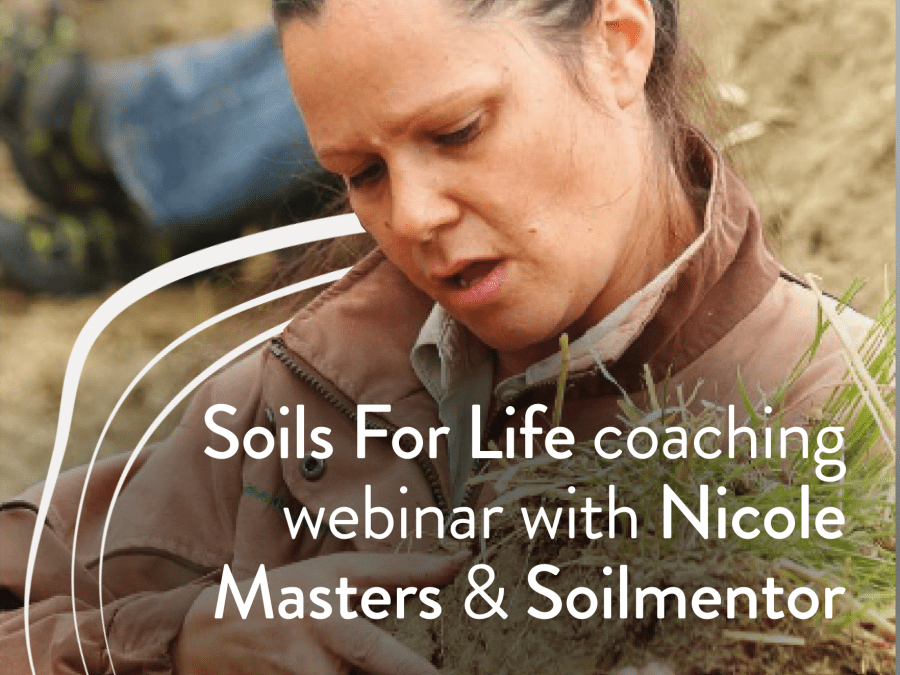
Soils For Life coaching webinar with Nicole Masters and Soilmentor

Soils For Life coaching webinar with Nicole Masters and Soilmentor 1764 1350 Soilmentor

In this webinar, agroecologist Nicole Masters speaks to three farmers from the Soils For Life (SFL) programme in Australia. SFL is a non-profit organisation that supports Australian farmers to regenerate their soils. In this session, Nicole explores each farmer’s individual context through their Regen Dashboard, helping them to figure out next steps to improve their soils.

Donna’s Farm

Donna Winter-Irving runs a mixed grazing enterprise just north of Melbourne. The farm currently runs 640 ewes and 260 lambs, with profits stemming from lamb, mutton and wool sales. Their goal is to regenerate their soils to reduce flood risk. 

First, Nicole assesses Donna’s images of a pasture that sees a lot of grazing activity with short recovery periods in between. Photos of this sample area indicate that the soil is highly compacted and unlikely to be absorbing and storing rainwater. There are also different shades of colour within the soil; Nicole suggests this is because water infiltration is concentrated at the top of the soil sample with little soil mixing occurring. A good way to test whether the different colours in your soil are related to infiltration is to spray the soil sample all over with some water and assess whether the colours even out after moisture is added. 

The second soil sampling location in Donna’s Regen Dashboard has heavy clay soil and little plant diversity. Donna describes this paddock as ‘constipated and really heavy’, with her aim being to aerate the soil without the use of machinery. Nicole shares that the key to aerating soils is to introduce more organic material, followed by plant diversity. It is important to examine; are you seeing litter build-up? If so, what colour is it? Do you see greys, blacks or whites? Generally, if you encounter more whites in the plant litter, this can indicate that your plants aren’t good biological material for microbes to feed on. Nicole elaborates that once we improve the nutritional profile of our plants, they’ll become more of a golden colour when decomposing. She also suggests looking at livestock dung; poor litter breakdown will correspond with the speed and efficiency of your dung breakdown, and you’ll see fewer beetles in low quality forage dung.

Lastly, Nicole emphasises the use of livestock as a tool for mixing your soils. It is important to ask: what can I give to my animals to make their dung more palatable for dung beetles, worms and soil biology? These might look like prebiotics, probiotics or anything to stimulate the rumen or gut of the livestock being grazed. A good manure should be gone within two days of its deposit, having been incorporated into the soil by dung beetles and other burrowing organisms.

James’s Farm

James Manning runs a 1200 acre thoroughbred horse farm with a small cattle herd, just north of Melbourne. They have been moving towards a more sustainable way of managing soil health on the farm. 

The first sample is from a paddock that has been sown with a multiple species equine mix. The paddock has historically been compacted, with low calcium and magnesium. In the last couple of years, James has cultivated the soil to break up compaction, as well as adding dolomite and green manures. James has recently taken brix barometer readings in the field, tracking how they change over time in accordance with what he is adding to the soil; an initial brix comparison between some cereal oats and fat hen from the paddock found that the fat hen had a higher brix reading, indicating that the soil is favouring the growth of non-desirable plant species over crops. After applying a foliar spray with calcium and sea minerals to the paddock, James found that the brix readings changed; the cereal oats now read higher on the refractometer, with the fat hen reading lower. Nicole explains how this shift in brix readings shows that the crops are now in a healthier condition than the weeds. Nicole also adds that an abundance of fat hen in a paddock can be an indicator of accumulated nitrates in the soil. 

Note: Brix readings are most accurately measured early in the season, before a plant starts sending sugars up to the seed head and leaves of the plant when it is nearing the end of its life cycle. This process will occur differently in perennials; these sugars will travel back down to the roots of the plant after seeding has occurred, in preparation for next years flowering cycle.

Russell’s Farm

Russell manages a 70 hectare farm in southern New South Wales. He has a mixture of cropping, livestock and rice paddies with the view to researching regenerative rice growing methods.

A few small observations from Russell’s first sample site indicate that there is a lack of soil biology; Nicole spots that the rows from previous year’s seedings are still intact, indicating that biological activity hasn’t smoothed over the surface of the soil as it should have done. However, Nicole also spotted that there is some evidence of saprotrophic fungi; this often occurs as dark green circles of ground coverage in the field, which will house a layer of thick mesh-like hyphae under the soil surface. The dark green growth shows that the fungi is active and releasing a lot of phosphorus and nutrients below, which is great to encourage across your whole property! 

Russell has also been spending some time testing the pH of his soils. He has found that in the lower soil profile, his soils are more neutral or slightly alkaline in pH, but in the upper soil profile, the soil was much more acidic. Nicole suggests that sodium in the lower layers of his soil profile could be contributing to the alkaline pH reading, and that it is always worth taking soil samples from both 0-15cm and 15-30cm sections of your soil profile and sending them off to the lab to discover what minerals could be lying untapped. An extension of this exercise could be to test the pH of some rhizosheath soil to compare to the surrounding soil. This is a great way to test whether your rhizosheaths are protecting your plant roots; a healthy rhizosheath can protect your plant’s roots by up to two units in pH. A top tip to give your plant’s roots and rhizosphere a boost is to bioprime your seeds before sowing.

Key Takeaways

  • Make sure to assess whether your soil has different shades of colour in it. If yes, then assess whether these shades are due to localised moisture or another factor

  • What colour do your plants turn when they are decomposing? If your plants decompose to shades of white, this can tell you that your plants aren’t good biological material for microbes to feed on. If your plants are turning a golden colour, they are very good biological material for microbes

  • Think about using animal prebiotics and probiotics! A healthy animal rumen or gut will help support the development of underground biodiversity, and therefore the breakdown of organic matter

  • If you don’t have any machinery, then grazing will be your number 1 tool for enhancing soil biodiversity

  • Make sure to test the brix barometer readings of your crops and compare it with your weeds – this can be especially useful to track before and after foliars or inputs have been added to the soil

  • Try testing the PH of the upper (0-15cm) and lower (15-30cm) portions of the soil profile, you’ll likely find that the results are different. You can also test the rhizosphere soil and compare it to surrounding soil, to indicate how much your rhizosphere is protecting your roots from the PH of the soil

  • Bioprime your seeds to give them boost into developing a healthy rhizosphere

Thank you to Soils For Life and Nicole Masters for hosting this webinar! We love seeing how farmers using Soilmentor can learn from their observations using the Regen Platform, or by sharing their results remotely to consultants and coaches.

Get in touch with us at info@vidacycle.com if you are interested in using Soilmentor with your farming network or organisation!

Regenerate Outcomes coaching webinar with Nicole Masters & Vidacycle

Regenerate Outcomes coaching webinar with Nicole Masters & Vidacycle 1431 1080 Soilmentor

In this webinar, agroecologist and regenerative farming adviser, Nicole Masters, talks to some Regenerate Outcomes farmers to discuss how they are using the Soilmentor app.

Regenerate Outcomes (RO) supports farmers to grow profits and improve crop and livestock performance by building functional soil. RO farmers can receive one-on-one mentoring from experienced regenerative farmers to increase the productivity of their soil, cut costs and reduce external inputs.

Get in touch with us at info@vidacycle.com if you are interested in using Soilmentor with your farming network, organisation or just your individual farm!

Soils For Life coaching webinar with Nicole Masters & Vidacycle

Soils For Life coaching webinar with Nicole Masters & Vidacycle 1187 920 Soilmentor


Soils For Life coaching webinar with
Nicole Masters & Vidacycle

In this webinar, agroecologist Nicole Masters speaks to three farmers from the Soils For Life (SFL) programme in Australia. SFL is a non-profit organisation that supports  Australian farmers to regenerate their soils; this webinar is part of SFL’s Cropping Resilience project where they have funding for Australian grain growers to use Soilmentor. In this session, Nicole explores each farmer’s individual farming context through their Regen Dashboard and offers tailored advice to improve their soils. 

Jessica’s Farm

First Nicole spoke to farmer Jessica about bluegum land recovery and indicator plants. Jessica shares how it has been a slow process regenerating the land in the three years since the removal of bluegum trees that were previously being farmed. Nicole suggests planting some fast growing species (for instance sunflower or oats), as well as adding worm castings to the soil to kick start the process of breaking down the wax coatings left behind by the bluegums.

We also look at Jessica’s Regen Dashboard to explore a field which has historically been and has remained arable. This field had better aggregation and earthworm counts. In a photo of the field, Nicole identifies onion grass growing between rows of oats; onion grass can be an indicator of poor functional calcium, which can be remedied by foliar sprays or biopriming the seeds before sewing. 

Peter’s Farm

Next, Nicole spoke to was Peter from NSW about clay soil compaction, ethylene and soil cracking. Peter has two sites: a former cropping paddock and a bambatsi pasture. Peter describes how his soils are very heavy clay, with very slow infiltration rate, no earthworm presence, and shallow rooting depth. Nicole describes Peter’s soils as ‘constipated’; there is a lot of undigested material on the top layer of soil, indicating an obstruction to the nutrient cycle.

In this case, Nicole diagnoses the release of Ethylene natural gas which builds up when soils get water logged. Ethylene hinders roots from growing further down into the soil and forming root hairs; this results in a cessation of rhizosheath formation and inability to absorb nutrients in the plant due to the interruption of the rhizophagy cycle. Nicole suggests an application of salicylic acid to the soil will help plant health and defence, encouraging deeper root growth and root hair formation. This can be achieved by applying soaked willow chip or adding 2-3 aspirin per mixing tank.

Next, Nicole analyses a photo of a milk thistle root that had grown down into a soil crack filled with loose top soil. Nicole suggests that Peter needs to plant some deep rooting plants, such as chicory, to break up the solid clay layer underneath the topsoil. She also suggests reintroducing worms to the soil by purchasing sods of soil with worm eggs to recolonise the fields.

Alan’s Farm

Lastly, Nicole speaks to Alan from Rosedale Farm in southern Queensland about indicator plants and slake tests. Alan describes his observation of milk thistle in his fields; Nicole shares this indicates that the soil is detoxifying from long-term chemical use or heavy metals. If the milk thistle is detoxifying a form of nitrate, then nitrate indicator plants, such as nettle, foxtail barley or cape weed, will also be present. The brix barometer reading of the milk thistle is also 2.5 higher than the brix reading of Alan’s crop, illustrating that the milk thistle is the plant ‘winning the game of life’.

Nicole also views some of Alan’s slake test results. Nicole expands on how slake tests are a very strong indicator of the level of microbial activity in the soil; this is because microbial activity forms a glue which holds soil together to form aggregates. Another indicator of life in your soil aggregate is the presence of gas bubbles after time, which shows that the microbes are respiring.

Other Key Takeaways:

You can learn a lot about the changes on your farm and the impact of your management decisions over time by taking photos. A visual benchmark is extremely useful!

Living roots do wonders for soil; getting anything to grow is the goal when you’re first starting to transition to a more regenerative farming system.

Weeds are indicators; understanding why an undesirable plant species is present can help to diagnose issues and find an alternative desirable plant species to take on its role in the ecosystem. Comparing Brix and leaf tests of weeds vs desired plants can help our understanding too.

How does your soil smell? Smell can be a great indicator of soil health.

When in doubt, Nicole’s number one indicator for soil and landscape health: how does your land make you feel?

Thank you to Soils For Life and Nicole Masters for hosting this webinar! We love seeing how farmers using Soilmentor can learn from their observations using the Regen Platform, or by sharing their results remotely to consultants and coaches.

Get in touch with us at info@vidacycle.com if you are interested in using Soilmentor with your farming network or organisation!
NFFN coaching webinar using Soilmentor with Nicole Masters

NFFN coaching webinar using Soilmentor with Nicole Masters 1431 1080 Soilmentor

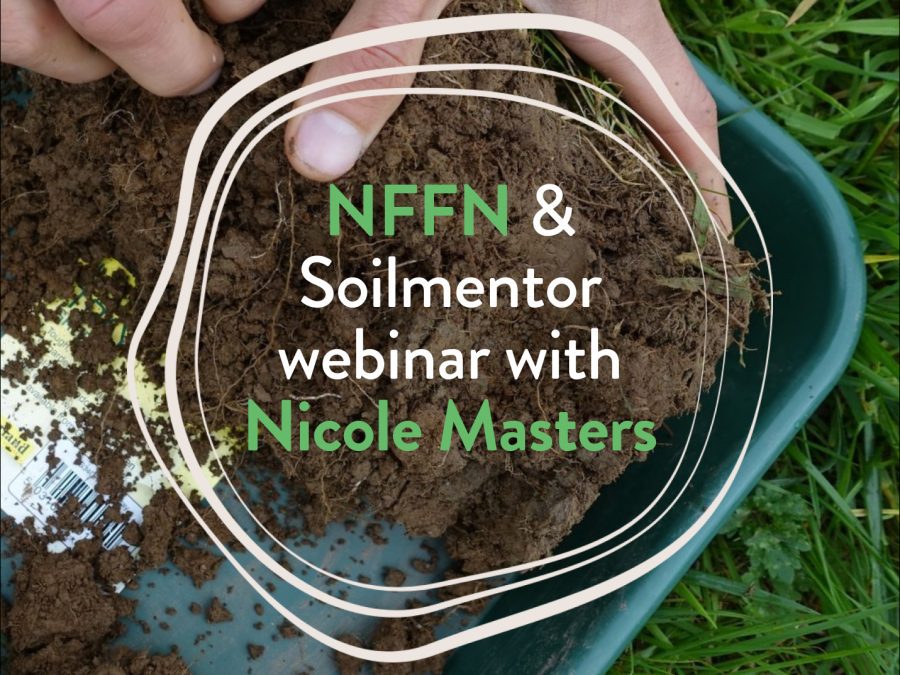
Nature Friendly Farming Network (NFFN) coaching webinar using Soilmentor with Nicole Masters

In this webinar, Nicole Masters (brilliant agro-ecologist and author of ‘For the Love of Soil’) coaches three farmers from the Nature Friendly Farming Network (NFFN) Soil Health Initiative using Soilmentor and their Regen Indicator results. NFFN are working with The Nature Recovery project to help farmers transition to regenerative agriculture. They are collecting results and observations with Soilmentor and using the Regen Platform to guide the improvement of their soils. Nicole dives into their specific farm contexts, challenges, and shares how small shifts can change the entire soil ecosystem of a farm.

Charles’s Farm

First, Nicole speaks to farmer Charles Paynter, whose Regen Indicator dashboard shows recordings taken on a winter wheat field, a winter barley field and a hay ley field, all on chalky boulder clay soil. These arable fields soil structures were compacted, with slow infiltration rates, and we learn that the compaction here has lead to limited air space, and therefore less microbial activity. Nicole advises Charles to limit use of ammonia nitrates and artificial inputs to avoid stunting fungal network growth and soil microbial community building. Instead, Nicole suggests bio-priming seeds by planting them with compost and natural bio-stimulants. Looking at Charles’s photos recorded on Soilmentor, Nicole can see that his grassland soil system is starting to rebuild itself, benefitted greatly by the presence of the deep rooting grass, adding structure and attracting worms.

Stephens’s Farm

Next, Nicole speaks to Stephen Selley, who has been restoring ponds and grassland to support populations of Great Crested Newts breeding in the area. Stephen’s fields show low rooting depth, long infiltration rates, very limited rhizosheaths and few earthworms. Nicole advises seeding a diverse cover crop mix including deep-rooting chicory into the soil, to create a deeper soil structure, aid in infiltration, bring diversity into the field and help with compaction.

Martin’s Farm

Finally, Nicole chats to Martin Lines, CEO of NFFN, to discuss reducing cultivations, suppressing weeds, and cover crops. The two fields Nicole examined with Martin were a large arable field currently in production, and a field in its third year of herbal ley due to a previous weed burden. Martin has been experimenting with letting livestock graze both fields for added nitrogen. Both of these fields had poor infiltration rates; Martin has previously tried bio-stimulants for the soil, however found that they didn’t increase root growth, which is his main aim for increasing infiltration rate. Nicole advises that each soil system will suffer if there is a problem with any of the ‘three Ms’: microbiome, mineral imbalance or (organic) matter. Martin’s fields however don’t require pesticide use, as they have found plenty of predatory insects keeping pest populations under control. Martin has also found that after applying a layer of straw mulch to his fields alongside fungicide, the straw breaks down a lot slower than without a fungicide application.

We love seeing how farmers using Soilmentor can learn from their observations using the Regen Platform, or by sharing their results remotely to consultants and coaches.

Get in touch with us at info@vidacycle.com if you are interested in using Soilmentor with your farming network or organisation!

Soils for Life (AU) – using Soilmentor as an organisation to monitor regenerative progress

Soils for Life (AU) – using Soilmentor as an organisation to monitor regenerative progress 2510 1284 Soilmentor

Soils for Life Australia use Soilmentor as a Key Tool in their Regenerative Transition Programme

Soilmentor supporting remote coaching with Nicole Masters

Soils for Life is an independent, not-for-profit organisation that works across Australia to support farmers in regenerating soils and landscapes, to build natural and social capital, and transform food and fibre systems. As part of their farmer-led Paddock Labs initiative, the farmers and Soils for Life team had access to Soilmentor for a year to  monitor their soils, record day-to-day observations and to experiment and learn together from their results.

In Spring, the farmers joined an exclusive online mentoring session with Nicole Masters. Using Soilmentor they were able to each share results from their Regen Indicator tests in key paddocks and benchmark their results in the Regen Platform. It was brilliant to see such focused support, as Nicole was able to work directly with each farmer on the results they were seeing in their fields, giving them confidence and insights into where to go next in their specific context. This was taking the things to the next level from a more general learning webinar, as it helped farmers to build on their skills to think regeneratively and apply learnings based on what they were seeing.

Watch the video below to learn more about the Regen Indicators and to see how they work in this context, and how Soilmentor can be an important tool for organisations working with farmers on their regenerative journey and enable access to high quality support through remote coaching.

If you are part of a farming group, organisation or cluster, and are interested in buying a Soilmentor group package, please get in touch with us on info@vidacycle.com!

Soils for Life training video – using the Regen Platform, with Nicole Masters

Why use Soilmentor as an organisation?

Empowering farmers in the field – allowing farmers to monitor their own soil health & record simple day to day observations to document the regenerative journey (e.g. wildlife observations, inputs added, and grazing patterns).

Sharing results – data collected and observations made can be shared remotely to anyone in the team or group. The platform can be used as a knowledge exchange between the farmers, advisors and the organisation team.

Back up decisions & recommendations with robust data and monitor group progress made towards objectives.

Supporting farmers to experiment with innovative practices and build knowledge, allowing you to document what is and isn’t working on the farm.

Farmerama #73: Nicole Masters on the Regen Platform

Farmerama #73: Nicole Masters on the Regen Platform 1000 668 Soilmentor

Nicole Masters interview on Farmerama:
The Regen Platform

Episode #73 of Farmerama Radio featured Abby interviewing Nicole Masters on the power of digging a hole, the inspiration behind the Regen Indicators, and how the Soilmentor Regen Platform can support a regenerative transition.

Tune into the full episode below (or on your preferred podcast platform):

Do you dig holes on your farm? Does the Regen Platform sound interesting to you? Get in touch with us at info@vidacycle.com – we’d love to hear from you 🙂